Imaging Artifact?
Click on thumbnail image for larger
image
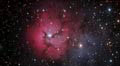
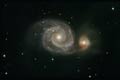
A little bit of information on the above images. These
were taken with the Moon about 44% but not anywhere close as best as I can
tell. In fact I believe the Moon was in the west when these images were
taken with the telescope facing east so I don't think they are having any
affect other than possibly some gradient. The optical tube is a 12.5" RC and
the imaging equipment is a SBIG STL-11000, CW8 w/LRGBHa filters, AO-L, and
Pyxis 3" rotator. I didn't notice these arcs until after the raw data was
already acquired. The above images are raw uncalibrated images stretched
quite a bit to clearly show these arcs. M45 data was acquired first and only
has a single arc in the upper left corner of the image and that's true in
all of the 12 - 20 minute subs acquired. The M44 data was acquired next and
clearly shows multiple arcs with two on the bottom, two on the right side
and one in the upper right corner. The data was acquired between
December 31 at 7:44 PM and ending on January 1 at 4:01 AM. All images taken
at -35° binned 1x1. I have imaged close to the Moon
before and have not had these artifacts or reflections as a result. I'd try
to replicate this this evening but it doesn't look good weather wise. Images
taken on December 29 at 3:26 AM of M44 do not show these arcs. The Moon then
would have been at 26%.
Update 01/02/2012
Bob Franke, a member of the SBIG Forum
replied to my request for help and recognized this pattern from an issue
that Mark Manner had experienced in the past with his AO-L and MOAG as being
reflections off the AO paddle. Mark was able to eliminate his by using
Velcro to flock the square side of his AO-L where it connected to his
AstroDon MOAG. While this didn't cure my issue it certainly got me to the
proper cause but in my case I also needed to flock the Optec AO-L 3" Pyxis
adapter. While that is about 3/4" deep I decided to cut my flocking
material, Protostar flocking
paper, to an additional 2", which while still having the backing paper
on this additional 2", inserted freely into the Pyxis giving some additional
reflection protection. It may not have been needed but it certainly didn't
hurt anything. The image below is the same data acquired from the identical
ACP plan used for the above M45 with exception of the added flocking. The
image is 1 - 20 minute each of red, green, and blue calibrated and combined
for the RGB image. Notice the arc in the upper left corner no longer exists.

click image for larger size
Update 01/08/2012
Further testing after removing the additional 2" of loose
flocking paper, flocking additional shinny surfaces both in the rotator and
adapter. Extreme stretches continue to show the arcs. I went back to when I
originally received the STL-11000 and did not have the AO-L in place and could
not see these arcs at all. After installing the AO-L several months later it
appears these arcs appeared. This however doesn't convince me that the arcs are
caused by the AO at all times but maybe due to the nature of the AO itself with
tilting and tipping while corrections are being made is causing the light path
to bend enough to possibly strike a reflecting surface causing the arcs. None
the less finding this cause and effect is proving to be a challenge. The arcs
are most prominent on very bright objects and blend into the background in
images such as M33. Please see the image below. It is a single 20 minute
luminance taken during an almost full moon and the quality of the image is not
at question but rather the arcs of which there are two. One in the upper left
corner and one on the middle right side.

click image for larger size
Update 01/12/2012
No moon at this time and only time for a few 20 minute
images due to incoming clouds and wind. This single 20 minute highly stretched
red image is bin 1x1 and shows no signs of the arcs as above. Maybe an
improvement but will need to do additional imaging to make sure. Maybe just an
influence of the moon after flocking was done. I had taken moon images using the
Ha filter and stretched them ridiculously far didn't see anything out of the
usual.


|